
Learning Chinese can be an exciting journey for students, professionals, travellers, and language enthusiasts. One of the first steps toward understanding written Chinese is becoming familiar with Chinese characters. Unlike English, Chinese does not use an alphabet in the same way. Instead, it uses characters that represent meanings, sounds, or combinations of both.
For beginners, learning characters may initially seem difficult, but a consistent study routine can make the process easier. By understanding stroke order, recognising recurring components, learning pronunciation, and practising vocabulary in context, learners can gradually improve their reading ability.
This guide explains how to learn Chinese characters effectively, understand basic language structures, and develop practical reading skills.
1. Understanding the Basics of Chinese Characters
Basic Chinese characters, also known as Hanzi (汉字), are the written symbols used in the Chinese language. Some characters represent individual meanings, while others combine to form words and expressions.
For example:
- 人 (rén) – Person
- 大 (dà) – Big
- 学 (xué) – Study or learn
- 好 (hǎo) – Good
- 水 (shuǐ) – Water
Many Chinese words contain two or more characters. For example, 学生 (xuéshēng) means student, where 学 means study and 生 relates to life or birth in this word formation.
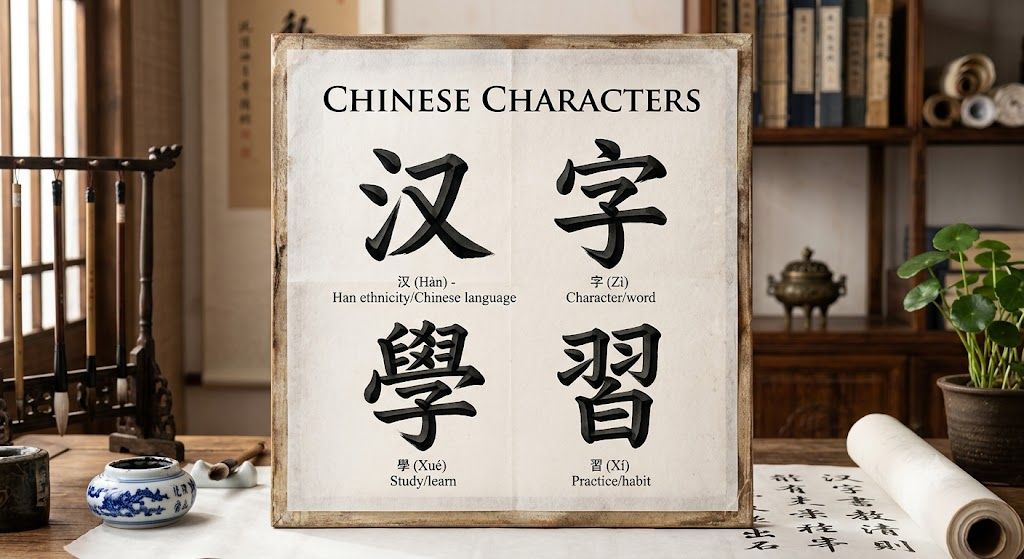
Authentic Chinese Characters learning begins with understanding that characters are not random drawings. Many contain recurring components that can provide clues about meaning or pronunciation. Recognising these components can help learners remember new vocabulary more effectively.
Learn Characters Through Meaning and Context
Instead of memorising a character without context, study it with a word, translation, pronunciation, and example sentence. This approach helps you understand how the character works in everyday communication.
For instance:
- 学 – Learn or study
- 学生 – Student
- 学校 – School
- 学习 – Study or learning
This method connects one character to several related words and makes vocabulary revision more meaningful.
2. Chinese Grammar: Build a Strong Language Foundation
Learning characters is important, but reading comprehension also depends on understanding how words are arranged in sentences. Chinese grammar generally follows a subject–verb–object pattern in many basic sentences, although word order can change depending on the meaning and structure.
For example:
- 我吃饭。(Wǒ chī fàn.) – I eat.
- 他喜欢茶。(Tā xǐhuān chá.) – He likes tea.
- 我学习中文。(Wǒ xuéxí Zhōngwén.) – I study Chinese.
Credible Chinese Grammar practice helps learners understand the relationship between characters and sentence meaning. Rather than translating every sentence word by word, beginners should learn common sentence patterns and use them repeatedly.
Learn Sentence Patterns Alongside Characters
When learning a new character, try to identify how it appears in simple sentences. This technique improves reading comprehension and helps you understand grammar naturally.
For example, when learning the character 我 (wǒ), practise sentences such as:
- 我是学生。– I am a student.
- 我喜欢中文。– I like Chinese.
- 我学习汉字。– I study Chinese characters.
Comprehensive Chinese Grammar study does not require memorising every rule at the beginning. Start with basic sentence structures, question forms, negation, measure words, and common time expressions. Gradually increase the complexity as your vocabulary grows.
3. Start with Common and Useful Characters
Beginners should focus on frequently used characters instead of trying to memorise hundreds of unfamiliar symbols immediately. Common characters appear repeatedly in conversations, learning materials, signs, messages, and short reading passages.
You can begin with characters related to:
- Numbers
- Family members
- Food and drinks
- Daily activities
- Places
- Time and dates
- Basic descriptions
Budget-friendly Chinese Characters learning can be achieved with free or low-cost resources, including digital flashcards, printable worksheets, beginner reading materials, and language-learning websites.
Create a small list of characters each week. For example, you could learn five to ten characters per day, depending on your schedule. The goal should be long-term retention rather than memorising a large number of characters in one sitting.
Use Vocabulary Groups
Learning characters in related groups can improve recall. For example:
| Character | Meaning | Example |
|---|---|---|
| 日 | Sun/day | 日子 |
| 月 | Moon/month | 月亮 |
| 水 | Water | 水果 |
| 火 | Fire | 火车 |
| 木 | Wood | 木头 |
Some characters may have different meanings depending on the word or sentence in which they appear. Therefore, always review examples instead of relying on a single translation.
4. Learn Stroke Order Step by Step
Stroke order refers to the sequence in which the strokes of a Chinese character are written. Following common stroke-order principles can improve writing consistency, character recognition, and handwriting practice.
Several basic principles include:
- Writing from left to right.
- Writing from top to bottom.
- Writing horizontal strokes before vertical strokes in many common structures.
- Writing outer components before closing certain enclosures.
- Writing central components before side components in some characters.
The Ministry of Education of Taiwan provides an online stroke-order learning programme with character animations, search tools, pronunciation information, and practice resources. The programme includes thousands of character stroke-order animations. <Cite refs={["turn148228search0","turn148228search1"]}/>
Accurate Chinese Characters practice involves watching the stroke sequence, tracing the character, and then writing it independently. Do not focus only on copying the overall shape. Pay attention to the direction, length, position, and balance of each stroke.
Practise Writing Without Tracing
Use a three-step practice method:
- Step 1: Watch the stroke-order animation.
- Step 2: Trace the character several times.
- Step 3: Write the character without looking at the model.
After writing, compare your result with the original. This helps identify problems with proportions, spacing, and stroke placement.
5. Understand Radicals and Character Components
Radicals and recurring components can make character learning more organised. A radical may provide information about a character’s meaning, while another component may offer a clue about pronunciation. However, these clues are not always exact, and learners should confirm meanings and readings using a reliable dictionary.
For example, the water-related component 氵 appears in characters such as:
- 河 (hé) – River
- 海 (hǎi) – Sea
- 洗 (xǐ) – Wash
Trusted Chinese Characters resources often explain how characters are constructed and how their components relate to meaning or sound. Learning these patterns can reduce the feeling that every new character is completely unfamiliar.
Create Character Families
Group characters based on shared components, meanings, or pronunciation patterns. Maintain a notebook with the following information:
- Character
- Pinyin pronunciation
- Meaning
- Common words
- Example sentence
- Related components
This approach helps you review vocabulary systematically and recognise similarities between characters.
6. Use Pinyin to Improve Pronunciation
Pinyin is a Romanisation system used to represent the pronunciation of Mandarin Chinese. It helps beginners pronounce characters and connect written forms with spoken language.
For example:
- 你 – nǐ – You
- 好 – hǎo – Good
- 学 – xué – Learn
- 中 – zhōng – Middle or central
Mandarin also uses tones, which can change the meaning of a syllable. Learning the four main tones and the neutral tone is important for developing accurate pronunciation.
Reasonable Chinese Characters study should combine reading, listening, speaking, and writing. When learning a new character, listen to its pronunciation and repeat it aloud. This creates a connection between the written form and its spoken sound.
Combine Listening with Reading
Choose short audio-supported texts or beginner dialogues. First, listen to the sentence. Then read the characters, check the pinyin, and repeat the sentence.
This process helps you recognise familiar characters when they appear in natural speech and improves your overall language awareness.
7. Build a Consistent Daily Learning Routine
Regular practice is often more effective than studying for several hours only once a week. A simple daily routine can help you build confidence without feeling overwhelmed.
A 30-minute learning schedule could include:
- 10 minutes: Review previously learned characters.
- 10 minutes: Learn new characters and vocabulary.
- 5 minutes: Practise writing and stroke order.
- 5 minutes: Read short sentences or listen to audio.
Cost-effective Chinese Characters learning can be supported through free dictionaries, digital flashcards, online reading materials, and handwriting practice tools. Select resources that provide clear pronunciation, meanings, example words, and reliable character information.
Use Spaced Repetition
Spaced repetition means reviewing information at increasing intervals instead of repeating it continuously in one session. You might review a new character on the same day, the next day, three days later, and again the following week.
This method can help you identify characters that require additional practice. Adapt your review schedule according to how confidently you can recognise and recall each character.
8. Read Simple Chinese Texts
Once you have learned basic characters, start reading short and familiar content. Avoid choosing material that contains too many unknown words, as this can make reading frustrating.
Suitable beginner materials may include:
- Short dialogues
- Graded stories
- Children’s stories
- Basic descriptions
- Beginner-level articles
- Simple messages and signs
Premium Chinese Characters learning materials may include graded reading exercises, audio support, vocabulary explanations, and interactive comprehension questions. However, expensive resources are not essential for every learner. Choose materials based on your learning level, goals, budget, and preferred study method.
Read Without Translating Every Character
Try to understand the overall meaning of a sentence before checking every unfamiliar word. Mark unknown characters and review them after finishing a short passage.
This practice improves reading fluency and teaches you to use context. Over time, you may recognise familiar phrases without translating each character individually.
9. Avoid Common Learning Mistakes
Many beginners face similar challenges when learning Chinese characters. Understanding these difficulties can help you develop better study habits.
Memorising Too Many Characters at Once
Learning a large number of characters quickly may lead to weak retention. Focus on a manageable number and revise them regularly.
Ignoring Pronunciation
Knowing the appearance of a character without understanding its pronunciation can limit your communication skills. Practise pinyin and tones alongside vocabulary.
Depending Only on Flashcards
Flashcards are useful, but they should be combined with reading, listening, writing, and sentence practice. Characters become easier to remember when you see them in meaningful contexts.
Skipping Revision
Without revision, previously learned characters may become difficult to recall. Include older vocabulary in your weekly study routine.
Real Chinese Characters progress comes from active practice, regular revision, and exposure to meaningful language rather than relying on memorisation alone.
10. Choose the Right Learning Resources
The right resources can make your learning journey more organised. Look for tools that include character meanings, pronunciation, stroke order, example words, and practice activities.
The Ministry of Education’s stroke-order platform provides search functions based on characters, stroke count, radicals, and pinyin, making it useful for learners who want to investigate unfamiliar written forms. <Cite refs={["turn148228search0","turn148228search1"]}/>
When selecting a learning resource, consider:
- Your current Chinese level
- Whether you prefer simplified or traditional characters
- Availability of audio and pronunciation guidance
- Practice and revision features
- Learning cost
- Quality of explanations
- Compatibility with your learning goals
Consistent Chinese Characters practice becomes easier when you use a small number of dependable resources instead of constantly switching between unrelated learning systems.
Conclusion
Learning Chinese characters does not have to be an intimidating experience. By starting with common vocabulary, learning stroke order, understanding recurring components, practising pinyin, and reading simple sentences, you can gradually develop stronger reading skills.
A structured routine is more valuable than trying to memorise everything at once. Combine writing practice with listening, grammar exercises, and real reading materials to build a balanced foundation.
Whether you are learning Chinese for education, travel, professional development, or personal interest, regular practice can help you make steady progress. Set realistic goals, review what you learn, and celebrate small improvements as you develop your understanding of written Chinese.
Frequently Asked Questions (FAQs)
1. How long does it take to learn Chinese characters?
The time required depends on your learning routine, language background, study goals, and revision habits. Beginners can start recognising common characters within a few weeks of regular practice, but reading fluency requires ongoing study and exposure.
2. Should I learn pinyin before Chinese characters?
Learning basic pinyin before or alongside characters is helpful because it supports pronunciation and listening practice. However, avoid depending on pinyin alone. Gradually connect pronunciation with the written character.
3. How many Chinese characters should I learn each day?
There is no universal daily target. Beginners may start with five to ten characters per day and adjust according to their retention and available study time. Regular revision is more important than learning a large number of characters quickly.
4. What is the best way to remember Chinese characters?
Combine several methods, including writing practice, spaced repetition, vocabulary groups, pronunciation practice, and reading sentences. Understanding character components can also help you recognise related patterns.
5. Is stroke order important when learning Chinese?
Yes. Learning common stroke-order principles can support consistent handwriting, better character structure, and easier writing practice. It is useful to study stroke order from reliable learning resources.
6. Can I learn Chinese characters without writing them by hand?
Yes, you can develop reading recognition through digital tools and reading practice. However, handwriting practice can strengthen your understanding of character structure and help you remember stroke patterns.
7. Should I learn simplified or traditional Chinese characters?
Your choice should depend on your learning goals. Simplified characters are widely used in Mainland China and Singapore, while traditional characters are commonly used in Taiwan and Hong Kong. Consider the region, materials, and people you plan to communicate with.
8. How can I improve my Chinese reading skills?
Begin with short, level-appropriate texts. Review unknown vocabulary, read regularly, listen to accompanying audio when available, and gradually increase the difficulty of your reading materials.