
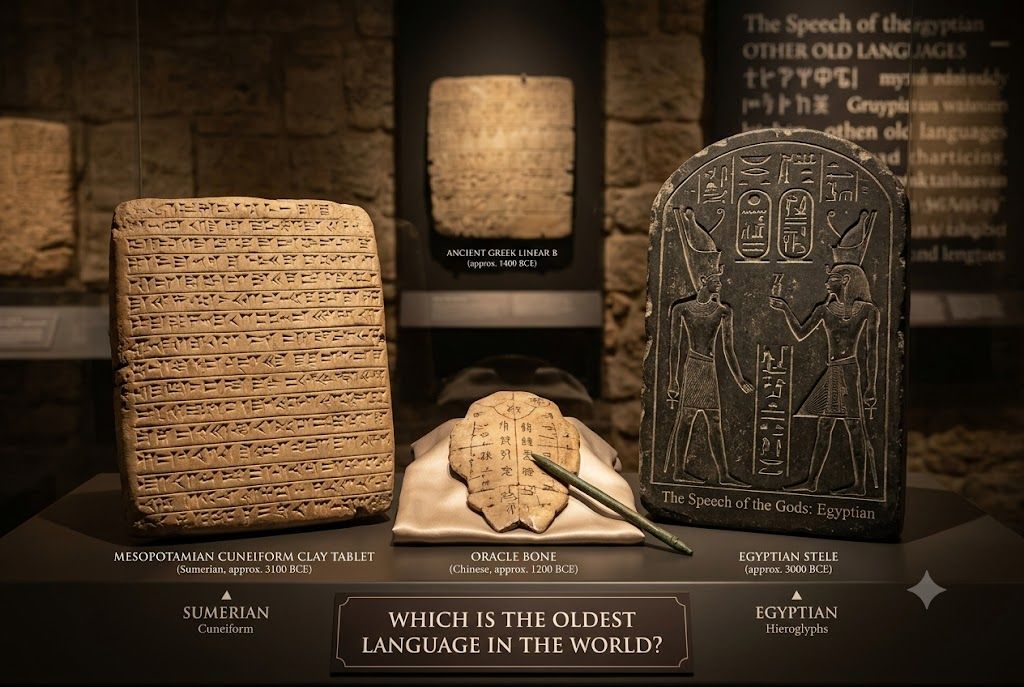
Human language has existed for far longer than writing, which makes the history of ancient languages fascinating—and difficult to measure precisely. We cannot know exactly which language was the first ever spoken because speech leaves no direct archaeological record.
What we can study is the historical evidence preserved through inscriptions, manuscripts, clay tablets, monuments, and other written records.
The Ancient top 10 oldest language in the world are therefore best understood as a selection of languages with exceptionally early documented histories rather than a definitive scientific ranking.
From Sumerian and Ancient Egyptian to Greek, Chinese, Tamil, and Arabic, these languages represent different stages of human civilisation and show how languages can survive, transform, influence one another, or disappear.
What Makes a Language “Old”?
Before exploring the list, it is important to understand what “oldest” means.
A language can be considered ancient based on several different criteria:
- Earliest known written evidence
- Length of documented history
- Earliest surviving literary records
- Continuity into later forms
- Survival as a living language
- Age of its writing system
These criteria do not always produce the same answer.
For example, Sumerian is one of the earliest documented languages, with written evidence from southern Mesopotamia dating to the end of the fourth millennium BCE. Ancient Egyptian also has written evidence from the late fourth millennium BCE and has an exceptionally long documented history.
Therefore, asking Historical which is the oldest language in the world requires a distinction between the oldest recorded language and the oldest language still spoken today.
Top 10 Oldest Languages in the World
1. Sumerian
Ancient top 10 oldest language in the world discussions almost always include Sumerian because it is one of the earliest languages known from written records.
Sumerian emerged in southern Mesopotamia, in present-day Iraq, toward the end of the fourth millennium BCE. Early clay tablets from around 3300–3100 BCE provide important evidence of writing associated with the language.
Sumerian is particularly interesting because it is a language isolate, meaning scholars have not established a known linguistic family containing closely related languages.
Although Sumerian eventually ceased to be a spoken mother tongue, it continued to be studied and used in scholarly and religious contexts for centuries.
2. Ancient Egyptian
Remarkable top 10 oldest language in the world lists also feature Ancient Egyptian because of its exceptionally long documented history.
Early Egyptian writing appeared in the late fourth millennium BCE. Evidence from Abydos has pushed the beginnings of Egyptian hieroglyphic writing to around 3250 BCE, although the development of the writing system was gradual.
Ancient Egyptian developed through several historical stages, eventually giving rise to Coptic, which remains important in the liturgical tradition of the Coptic Church. Oxford describes Egyptian as having more than four millennia of documented history.
3. Akkadian
Ancient top 10 oldest language in the world research also brings us to Akkadian, an ancient Semitic language used extensively in Mesopotamia.
Akkadian was written using cuneiform and became an important language of administration, literature, diplomacy, and scholarship.
It developed into major varieties including Babylonian and Assyrian. Akkadian's historical importance is especially visible in the large number of surviving texts from ancient Mesopotamian societies.
Its records provide valuable evidence about political systems, religion, trade, law, literature, and everyday life.
4. Elamite
Historical top 10 oldest language in the world discussions can also include Elamite, an ancient language associated with the region of Elam, primarily in southwestern Iran.
Elamite was used in different periods and writing traditions, and evidence for the language extends across a long span of ancient Iranian history.
Unlike languages such as Greek, Elamite did not develop into a major modern spoken language. Nevertheless, its inscriptions and administrative records provide important information about the ancient cultures of the region.
5. Greek
Classical top 10 oldest language in the world candidates include Greek, which has one of the longest documented histories among living language traditions.
The earliest forms of Greek are recorded in Linear B tablets dating to the second millennium BCE. Later forms include Ancient Greek, Koine Greek, Medieval Greek, and Modern Greek.
Greek has had an enormous influence on philosophy, science, medicine, mathematics, literature, politics, and academic vocabulary.
Unlike Sumerian and Ancient Egyptian, Greek has continued as a living language through major historical changes.
6. Chinese
Enduring top 10 oldest language in the world lists often include Chinese because of its extremely long written tradition.
Early Chinese writing is famously associated with oracle-bone inscriptions from ancient China. Over time, the Chinese language developed through historical stages, while its writing system also changed considerably.
Modern Chinese varieties are historically connected to this long tradition, although ancient written Chinese and modern spoken varieties should not be treated as identical.
The history of Chinese demonstrates that a language can undergo significant pronunciation, vocabulary, and grammatical changes while maintaining a strong written and cultural legacy.
7. Hebrew
Biblical top 10 oldest language in the world discussions frequently include Hebrew because of its ancient written and literary tradition.
Hebrew belongs to the Northwest Semitic branch of the Semitic language family. Biblical Hebrew appears in a substantial body of ancient religious and literary texts.
For centuries, Hebrew was used primarily in religious, scholarly, and literary contexts rather than functioning as the everyday spoken language of most Jewish communities.
Its modern revival as a spoken language is one of the most remarkable stories in language history.
8. Sanskrit
Literary top 10 oldest language in the world discussions often mention Sanskrit because of its extraordinary textual tradition.
Sanskrit is an ancient Indo-Aryan language associated with major religious, philosophical, scientific, and literary works of South Asia.
The Vedic tradition represents some of the earliest layers of Sanskrit-related linguistic material. Later Classical Sanskrit became highly developed as a literary and scholarly language.
Sanskrit has also influenced numerous South Asian languages through vocabulary, literature, religion, philosophy, and intellectual traditions.
9. Tamil
Living top 10 oldest language in the world lists often highlight Tamil because it combines an ancient literary tradition with continued use as a living language.
Tamil belongs to the Dravidian language family and has a rich body of classical literature.
Its long literary history is particularly significant because the language continues to be spoken by millions of people today.
However, describing Tamil simply as “the oldest language” would oversimplify a complicated linguistic question. Ancient written evidence, literary continuity, and spoken-language continuity are different measures.
10. Arabic
Cultural top 10 oldest language in the world lists can include Arabic because of its long historical development and major literary tradition.
Arabic belongs to the Semitic language family and has a particularly influential written tradition associated with Classical Arabic.
The language developed into numerous modern varieties spoken across different regions, while Modern Standard Arabic continues to be used in formal writing, education, media, and official contexts in many Arabic-speaking countries.
Which Is the Oldest Language in the World?
The answer depends on what you mean by “oldest.”
Historical which is the oldest language in the world is not a question with one universally accepted answer.
If we mean one of the earliest clearly documented written languages, Sumerian is a leading candidate, alongside Ancient Egyptian. ORACC describes Sumerian as the earliest documented language in Mesopotamia and says it vies with Egyptian for the title of oldest recorded language.
If we ask about the oldest continuously living language, the answer becomes much more complicated. Languages change constantly, so modern forms should not simply be treated as unchanged versions of languages spoken thousands of years ago.
This distinction is essential when discussing ancient language history.
Oldest Written Language vs Oldest Living Language
Which is the oldest language in the world comparisons should separate written history from spoken continuity.
Oldest Written Languages
Written records give historians physical evidence that can be dated and studied.
Sumerian and Egyptian are particularly important because their writing systems emerged around the end of the fourth millennium BCE.
Oldest Living Languages
A living language is one that continues to be spoken by a community today.
Languages such as Greek, Chinese, and Tamil have ancient documented histories and modern descendants or continuing forms, but they have changed substantially over time.
Therefore, “oldest living language” is a much more complicated category than “earliest recorded language.”
Why Did Some Ancient Languages Disappear?
Interesting top 10 oldest language in the world research also reveals that languages can disappear for many reasons.
Language replacement can occur because of:
- Political changes
- Migration
- Conquest
- Economic influence
- Cultural assimilation
- Changes in administration
- Expansion of another dominant language
- Decline of a speech community
Sumerian provides a notable example. Although it ceased to function as a mother tongue, it continued as a prestigious scholarly language for a long period afterward.
How Ancient Languages Influenced Modern Languages
Influential top 10 oldest language in the world examples demonstrate that ancient languages can continue to shape modern culture even after they change or disappear as everyday spoken languages.
Their influence can survive through:
- Vocabulary
- Religious texts
- Literature
- Place names
- Scientific terminology
- Writing systems
- Cultural traditions
- Historical scholarship
Greek and Latin, for example, have contributed extensively to scientific and academic vocabulary. Sanskrit has influenced South Asian languages, while Classical Arabic has had a major impact across the Arabic-speaking world and beyond.
Why Studying Ancient Languages Matters
Educational top 10 oldest language in the world topics are not simply about finding a winner.
Studying ancient languages helps researchers understand how societies communicated, governed, traded, recorded information, expressed beliefs, and preserved knowledge.
Written evidence can also provide insights into ancient economies, political structures, religious practices, social organisation, and cultural exchange.
For students, ancient languages offer an opportunity to explore the connection between linguistics, archaeology, anthropology, history, and literature.
Final Thoughts
Fascinating top 10 oldest language in the world research shows that language history is far more complex than a simple ranking.
Sumerian and Ancient Egyptian are among the earliest securely documented languages, while Greek, Chinese, Hebrew, Sanskrit, Tamil, and Arabic demonstrate the extraordinary depth and diversity of ancient linguistic traditions.
Rather than asking only Curious which is the oldest language in the world, it is more useful to ask what kind of “oldest” we mean: earliest written evidence, longest documented history, oldest literary tradition, or continued life as a spoken language.
Understanding that distinction makes the study of ancient languages more accurate—and much more fascinating.
Frequently Asked Questions
What is the oldest recorded language?
Direct which is the oldest language in the world answers commonly point to Sumerian and Ancient Egyptian as leading candidates for the earliest recorded languages. Sumerian written evidence dates to the end of the fourth millennium BCE, while Egyptian writing also appears during the same broad period.
Is Sumerian older than Egyptian?
Comparative which is the oldest language in the world research does not provide a simple winner. Evidence for both Sumerian and Egyptian reaches back to the late fourth millennium BCE, and the dating and interpretation of the earliest records require archaeological and linguistic context.
Is Tamil the oldest language in the world?
Popular which is the oldest language in the world claims about Tamil often refer to its ancient literary history and continued use. Tamil is certainly an ancient living language, but there is no universally accepted basis for declaring it the single oldest language in the world.
Which ancient languages are still spoken today?
Modern which is the oldest language in the world discussions may include Greek, Chinese varieties, Tamil, and Arabic because they have modern living language traditions connected to ancient written histories. However, these modern forms have changed considerably over time.
Why is Sumerian important?
Historical top 10 oldest language in the world studies frequently highlight Sumerian because it is one of the earliest documented languages and provides valuable evidence about ancient Mesopotamian civilisation.
Are ancient languages the same as their modern descendants?
Linguistic top 10 oldest language in the world comparisons should not assume that a modern language is identical to its ancient form. Languages naturally change in pronunciation, vocabulary, grammar, and usage across centuries.
What is the difference between a language and a writing system?
Educational which is the oldest language in the world explanations should distinguish speech from writing. A language is a system used for communication, while a writing system is a method for representing language visually. A writing system can sometimes be adapted to represent different languages.